
Campaigns rarely fail loudly.
They fail quietly.
You prepare everything.
You clean the list.
You refine the copy.
You configure your delay settings inside your WhatsApp bulk sender.
You click “Start Sending” expecting momentum.
At first, it looks normal.
Then messages slow down.
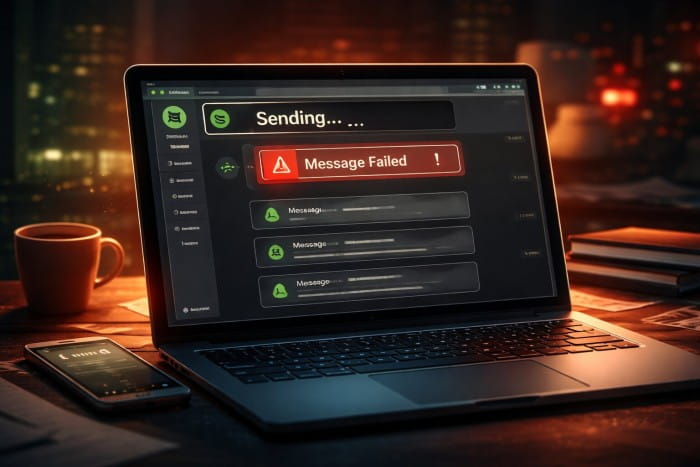
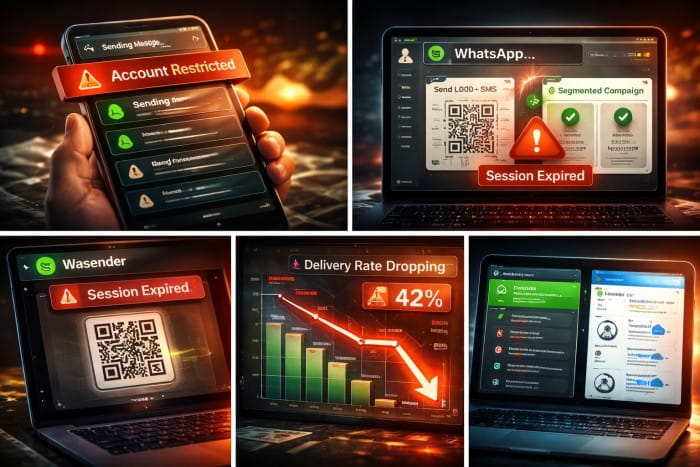
Some remain stuck at “Sending.”
A few show “Failed.”
Or your Wasender session disconnects without explanation.
That moment feels technical. But it isn’t just technical.
Because when your WhatsApp bulk message sender stops working, it doesn’t interrupt software. It interrupts business flow.
And that’s why most people misdiagnose the situation.
They blame the tool.
But most of the time, the tool is reacting to something deeper.
When a WhatsApp Bulk Sender Stops Working, It’s Usually Behavioral
WhatsApp doesn’t typically block aggressively at the first sign of automation. Instead, it adjusts delivery strength gradually.
First, delivery becomes inconsistent.
Then engagement drops.
Then your WhatsApp bulk sender starts behaving unpredictably.
You might see session expiration errors.
You might see messages queued but not delivered.
You might notice that your WhatsApp bulk SMS sender technically runs, yet recipients never receive the message.
This is rarely random.
WhatsApp constantly evaluates messaging patterns — not just content, but rhythm.
How quickly are messages being sent?
How similar are they?
Are recipients responding?
Are they blocking?
If your sending velocity spikes suddenly, especially from a new number, the platform quietly reduces trust.
It doesn’t always show you a warning.
It simply reduces effectiveness.
And that feels like a broken tool.
The Wasender Scenario: Connected, But Unstable
If you’re using Wasender, you’ve likely experienced session instability.
You scan the QR code.
It connects.
You feel relieved.
Then a few minutes later, the connection drops.
Or messages freeze mid-batch.
Or the interface lags unexpectedly.
You clear cache.
Reinstall the extension.
Restart your browser.
For a while, it works.
Then instability returns.
Here’s what’s happening.
Wasender operates through WhatsApp Web automation layers. When WhatsApp updates its interface or modifies session behavior, weaker automation structures struggle to stay aligned.
But there’s another layer most marketers overlook.
If your recent sending activity triggered behavioral flags — high volume, repetitive messaging, low engagement — session reliability often decreases.
It’s not always a bug.
It’s a reaction.
The Bulk SMS Mindset That Breaks WhatsApp Campaigns
In many regions, marketers approach WhatsApp like SMS.
High volume.
One message.
Mass broadcast.
But WhatsApp is not telecom infrastructure. It’s a relationship-based platform.
When you use a WhatsApp bulk SMS sender and push hundreds of identical promotional messages to cold contacts, the system measures the outcome.
Do people reply?
Do they ignore it?
Do they block you?
Low engagement combined with high repetition reduces your internal reputation score.
Over time, your WhatsApp bulk sender becomes less effective — even if the software itself is functioning perfectly.
Two businesses can use the same WhatsApp bulk message sender.
One experiences stable delivery.
The other constantly searches for “WhatsApp bulk sender not working.”
The difference is not the tool.
It’s the messaging structure.
The Dangerous Combination: New Number + Immediate Automation
This is the most common trigger.
A fresh SIM card.
A new WhatsApp account.
Instant bulk sending.
From your perspective, it’s efficient scaling.
From WhatsApp’s perspective, it’s abnormal behavior.
New accounts require behavioral warming.
They need conversation history.
They need replies.
They need organic interaction signals.
When a brand-new number suddenly uses a WhatsApp bulk sender to distribute hundreds of promotional messages, the system tightens delivery capacity.
You don’t always get banned.
You just lose effectiveness.
And that’s when you assume your WhatsApp bulk message sender is broken.
Why Some Marketers Never Experience These Issues
It’s interesting to observe that not everyone struggles.
- WhatsApp Marketing
BotMaster Business Bulk Sender – WhatsApp Marketing Software for Business Teams
Price range: 0.00$ through 299.00$ Select options This product has multiple variants. The options may be chosen on the product page - Marketing Tools
Bulk Pilot – A Simplified WhatsApp Marketing Tool for Efficient Automation
Price range: 0.00$ through 59.00$ Select options This product has multiple variants. The options may be chosen on the product page - WhatsApp Marketing
Lead Wave WhatsApp Marketing Software with AI Chatbot & Automation
Price range: 0.00$ through 299.00$ Select options This product has multiple variants. The options may be chosen on the product page - WhatsApp Marketing
WaCRM WhatsApp CRM Software for Sales, Marketing, and Customer Support Teams
Price range: 0.00$ through 199.00$ Select options This product has multiple variants. The options may be chosen on the product page - WhatsApp Marketing
WaDefender WhatsApp Account Strength Analyzer & Safety Software
Price range: 0.00$ through 99.00$ Select options This product has multiple variants. The options may be chosen on the product page - WhatsApp Marketing
Wasender Bulk WhatsApp Sender Software for Business Communication
Price range: 0.00$ through 199.00$ Select options This product has multiple variants. The options may be chosen on the product page


Some agencies run WhatsApp campaigns for months without major interruptions.
They use the same category of tools. Sometimes even the same tool.
So what’s different?
They scale gradually.
They segment their contact lists.
They rotate message variations.
They avoid sending massive identical batches in short windows.
They encourage replies rather than just pushing offers.
In other words, they treat automation like a layer — not the engine.
Their WhatsApp bulk SMS sender works because their strategy supports it.
When the Software Is Actually the Weak Link
Now, let’s be fair.
Not every failure is strategic.
Some WhatsApp sender software is simply unstable.
If your WhatsApp bulk sender disconnects constantly, lacks delay configuration, doesn’t receive regular updates, or offers no campaign management tools, then structural instability is inevitable.
WhatsApp evolves continuously. Tools that don’t adapt quickly will break.
If you find yourself reinstalling every few days, clearing cache repeatedly, or manually reconnecting sessions multiple times per campaign, that’s not user error.
That’s fragile infrastructure.
And fragile infrastructure creates unpredictable campaigns.
Diagnosing the Problem Without Guessing
Before making drastic decisions, run a simple test.
Open WhatsApp Web manually.
Send two natural messages to contacts you normally communicate with.
If those messages fail, your account reputation is restricted.
If they deliver successfully, your issue lies in configuration, sending behavior, or tool instability.
This single test saves hours of blind troubleshooting.
Then reduce sending speed immediately.
Pause large batches.
Allow the account to stabilize before resuming campaigns.
Automation must simulate human rhythm, not machine repetition.
The Strategic Reset That Restores Stability
If your WhatsApp bulk sender is currently unreliable, the smartest move is not switching tools instantly.
It’s adjusting your structure.
Lower your daily sending volume temporarily.
Introduce message variation.
Break your list into smaller segments.
Use realistic delay intervals instead of uniform timing.
Warm up new accounts properly before scaling.
When you align behavior with platform expectations, delivery improves naturally.
Your WhatsApp bulk message sender feels stable again.
Not because the tool changed.
But because your approach did.
The Real Difference Between “Not Working” and “Working Consistently”
At surface level, the issue looks technical.
At a strategic level, it’s behavioral alignment.
WhatsApp rewards patterns that resemble real conversations.
It resists patterns that resemble mechanical broadcasting.
If you treat your WhatsApp bulk sender as a high-speed blast engine, instability will be constant.
If you treat it as controlled automation layered on top of relationship-driven messaging, campaigns become predictable.
And predictability is what business operators truly need.
Final Perspective
If your Wasender session keeps disconnecting, your WhatsApp bulk SMS sender isn’t delivering, or your WhatsApp bulk message sender suddenly feels unreliable, don’t jump to conclusions.
Analyze sending speed.
Analyze engagement rate.
Analyze account age.
Analyze infrastructure stability.
Bulk messaging still works.
But only when structure supports scale.
When automation follows strategy — not replaces it — your WhatsApp bulk sender stops “mysteriously” failing.
It starts performing consistently.
And consistency, not volume, is what builds long-term revenue..